ICI / INSTITUTIONAL PAINTING
ICI Painting Contractors — Hospitals, Schools & Institutions in Ontario
P&G Renovation is a trusted ICI painting contractor specializing in institutional, commercial, and industrial projects across Ontario. Since 2017, our team has painted hospitals, schools, fire stations, hockey arenas, government buildings, and other large-scale facilities. We understand the unique requirements of institutional environments — strict compliance standards, specialized coatings, infection control protocols for healthcare settings, and the need to work around active operations. Our crew of 10+ experienced painters handles projects of all sizes, from single-floor school refreshes to multi-phase hospital renovations. WSIB certified and fully insured.
WHAT'S INCLUDED
ICI / INSTITUTIONAL PAINTING — WHAT ACTUALLY MATTERS
ICI — industrial, commercial and institutional — painting is the core of P&G Renovation's business. Over the past several years our crews have completed work for the University of Waterloo, Juravinski Hospital, St. Joseph's Healthcare Hamilton, St. Joseph's Villa in Dundas, Trillium Lakelands DSB, Kawartha Pine Ridge DSB, York Catholic DSB, Waterloo Catholic DSB, Conseil scolaire MonAvenir, the Simcoe Muskoka District Health Unit, the City of Markham and the City of Clarington. That work is specification-driven, deadline-bound and audited, and it is a completely different discipline from residential painting.
Institutional projects begin as documents. We read the specification section, review drawings and finish schedules, and price to the specified system rather than substituting a cheaper one and hoping nobody checks. Submittals go in before mobilization: product data sheets, SDS, colour draw-downs, WSIB clearance certificates, insurance certificates, site-specific safety plans and, where required, a bond. Our $2M bonding capacity and $10M liability coverage are what allow us to carry public and institutional tenders alongside private work.
The operational constraints are the hard part. Schools are painted during summer shutdowns, March break and Christmas break, on fixed windows that do not move — a corridor that is not finished by the first day of class is a serious problem, so we resource those projects to finish early rather than exactly on time. Healthcare work happens inside active facilities under infection-prevention-and-control protocols: ICRA barriers, negative-air machines, HEPA filtration, tacky mats, defined routes for material and waste, and daily coordination with infection control and facilities staff. Long-term care work is phased wing by wing so residents are never displaced. Municipal and emergency-services buildings such as fire stations stay operational throughout, which means apparatus bays are worked around live response requirements.
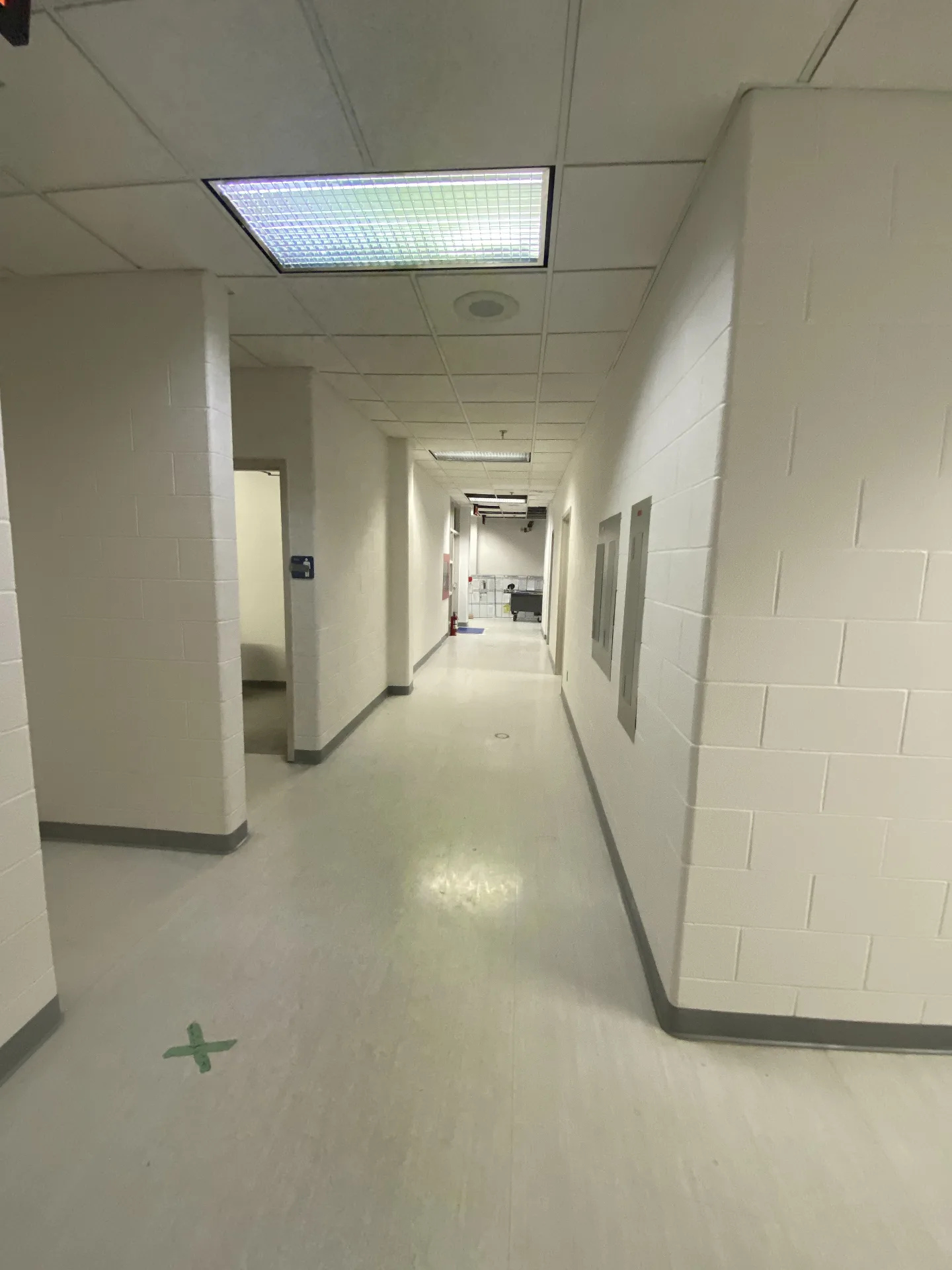
The coating systems are heavier duty than anything used in a house. Concrete block gets high-build block filler followed by pre-catalyzed waterborne epoxy so corridors and washrooms survive daily disinfection. Structural steel, hollow metal doors and frames, railings, stair stringers and bulkheads get rust-inhibitive DTM primers and industrial DTM topcoats. Exposed ceilings, joists, ducts, conduit and sprinkler piping in gymnasiums, arenas and open-plan spaces are sprayed with dry-fall coatings so overspray dries in flight. Labs get chemical-resistant epoxy. Exterior municipal surfaces often carry anti-graffiti clear coats to specification. Arena and recreation facilities frequently need a specialty primer-top-bond system over failed existing coatings — that is exactly what we used to bring the Orono Arena back.
Documentation closes the job. Deficiency lists are walked with the consultant, facilities manager or general contractor, punch items are cleared, and we hand over product records, colour formulas, batch numbers and warranty documentation so the facility can maintain and touch up the work for years. That paperwork is why institutional clients bring us back — a repaint that cannot be matched in three years is not really finished.
OUR ICI / INSTITUTIONAL PAINTING PROCESS, STEP BY STEP
Specification review and tender
Drawings, finish schedules and spec sections reviewed line by line; priced to the specified system, with a documented breakdown by area and substrate.
Submittals and pre-construction
Product data sheets, SDS, draw-downs, WSIB clearance, insurance certificates, bonding, and site-specific safety plans issued before mobilization.
Phasing and access planning
Sequencing agreed with the facility around shutdowns, breaks, shift patterns and live operations; keying, hoarding, storage, loading and security arrangements confirmed.
Containment and IPAC setup
In healthcare, ICRA barriers, negative-air units, HEPA filtration and tacky mats; elsewhere, hoarding, poly containment and dust control appropriate to the space.
Surface preparation
Washing and degreasing, block filling on CMU, rust removal to bright metal on steel, patching, bonding primers over incompatible or failed existing coatings.
Specified coating application
Institutional-grade systems applied to spec film build — pre-catalyzed epoxy, DTM, dry-fall, anti-graffiti and epoxy floor systems as scheduled.
Deficiency walk and closeout
Inspection with the consultant or facilities manager, punch-list completion, and handover of product, colour and batch documentation plus warranty.
MATERIALS & COATING SYSTEMS WE USE
We spec the coating to the substrate, not to the invoice. These are the systems and brands our crews work with day to day.
Walls and corridors
Sherwin-Williams Pro Industrial Pre-Catalyzed Waterbased Epoxy and Benjamin Moore Ultra Spec — hard, scrubbable and tolerant of hospital-grade disinfectants.
Concrete block
Heavy-duty block filler to fill the pore structure, followed by two coats of epoxy for a smooth, low-porosity, cleanable surface.
Steel, doors and frames
Rust-inhibitive DTM primers with industrial acrylic or urethane DTM topcoats on hollow metal, railings, stringers, bollards and structural steel.
Exposed ceilings and structure
Dry-fall coatings sprayed over deck, joists, ducts, conduit and sprinkler systems in gyms, arenas and open-ceiling spaces.
Floors and labs
Epoxy and urethane floor systems, chemical-resistant novolac epoxy in laboratories, and safety line marking to facility standards.
Specialty
Anti-graffiti clear coats, anti-microbial coatings, primer-top-bond systems over failed existing paint, and varnish systems on institutional wood doors.
TYPICAL TIMELINES
Durations are typical for a fully accessible site and are confirmed in writing after the on-site assessment.
SAFETY, WSIB & COMPLIANCE
P&G Renovation Ltd carries $10M commercial general liability, WSIB coverage in good standing and $2M bonding capacity. Certificates are supplied with every commercial and institutional proposal and on request for residential work.
OUR PROCESS
Scope & Tender
Detailed site assessment, specification review, and competitive pricing.
Project Planning
Coordinate phasing, access, and scheduling around facility operations.
Professional Execution
Systematic painting with proper containment and institutional-grade coatings.
Handoff & Documentation
Final inspection, touch-ups, and complete project documentation.
WHY CHOOSE P&G RENOVATION
ICI Specialists
Dedicated institutional division with experience in hospitals, schools, and government buildings.
Compliant & Certified
WSIB certified, fully insured, and knowledgeable about institutional coating standards.
Phased Scheduling
We work around active operations — nights, weekends, and school breaks.
RELATED SERVICES
ICI / INSTITUTIONAL PAINTING — FREQUENTLY ASKED QUESTIONS
Can you work inside an active hospital or long-term care home?
Yes. We have completed work at Juravinski Hospital, St. Joseph's Healthcare Hamilton and St. Joseph's Villa in Dundas inside occupied facilities. That means ICRA barriers, negative-air machines with HEPA filtration, tacky mats, defined material and waste routes, low-odour coatings and daily coordination with infection control — and phasing so residents and patients are never displaced.
Do you paint schools during the summer shutdown?
That is the bulk of our education work. We deliver summer, March break and Christmas break programs for Trillium Lakelands DSB, Kawartha Pine Ridge DSB, York Catholic DSB, Waterloo Catholic DSB and Conseil scolaire MonAvenir, including multi-school district programs. We resource those windows to finish ahead of the first day back rather than on the last possible day.
Are you bondable and can you provide the documentation our tender requires?
Yes. $2M bonding capacity, $10M commercial general liability and WSIB coverage in good standing. We supply certificates, clearance letters, product data sheets, SDS, colour draw-downs, safety plans and closeout documentation as a standard part of every institutional contract.
What coating system do you use on institutional corridors and washrooms?
High-build block filler where the substrate is CMU, then two coats of pre-catalyzed waterborne epoxy. It cures to a hard, low-porosity, scrubbable film that stands up to repeated cleaning with hospital-grade disinfectants, which is a requirement that conventional wall latex simply cannot meet.
AREAS WE SERVE
We provide ici / institutional painting services across the Greater Toronto Area and beyond. Choose your city for local pricing, project references and crew availability.